Τετάρτη 4 Ιουλίου 2012

ΑΦΙΕΡΩΜΑ, GLUCK CHRISTOPH WILLIBALD


GLUCK CHRISTOPH WILLIBALD


Ο Κρίστοφ Βίλιμπαλντ Γκλουκ (Christoph Willibald Gluck, 2 Ιουλίου 1714 – 15 Νοεμβρίου 1787) ήταν βοημικής καταγωγής συνθέτης όπερας.
Σε ηλικία 13 ετών εγκατέλειψε την πατρική εστία για να γίνει πλανόδιος μουσικός. Κατά βάση αυτοδίδακτος, εργάστηκε στην Πράγα και στη Βιέννηπροτού καταλήξει στην Ιταλία. Εκεί γνωρίστηκε με τον συνθέτη Τζιοβάνι Μπατίστα Σαμαρτίνι, υπό την προστασία του οποίου ξεκίνησε το 1741 τη σταδιοδρομία του ως συνθέτης του λυρικού θεάτρου γνωρίζοντας πολλές και σημαντικές επιτυχίες.
Το 1752 εγκαταστάθηκε οριστικά στη Βιέννη, παντρεύτηκε μια ευκατάστατη γυναίκα και συνδέθηκε στενά με την αυτοκρατορική αυλή. Οι όπερές του αυτής της περιόδου ήταν γραμμένες στα γαλλικά ή στα ιταλικά.
Η καινοτομία του Γκλουκ ήταν να προσθέσει δράμα στην όπερα, οδηγώντας τη σε νέα ύψη. Οι πιο δημοφιλείς του όπερες είναι οι Ορφέας και Ευριδίκη(1762), "Ο θρίαμβος της Κλέλιας" 1763, Άλκηστη (1767), Ιφιγένεια εν Αυλίδι (1774) και Ιφιγένεια εν Ταύροις (1779).
Από το 1781 αφού έπαθε εγκεφαλικό, έγραψε πολύ λίγο. Τελικά το 1787 ύστερα από δεύτερο εγκεφαλικό πέθανε σε ηλικία 73 ετών.


Επιλογή έργων
από μέλη της ομάδας
 "Ακούτε Κλασική Μουσική; Εγώ ακούω."


*Christos Sipsis
GLUCK - Che farò senza Euridice? (with lyrics)
Maria Callas - J'ai perdu mon Eurydice.wmv
Kathleen Ferrier - Gluck - Orfeo ed Euridice - Che Faro 1946
Janet Baker sings "Che farò senza Euridice" from Gluck's 'Orfeo ed Euridice'
Teresa Berganza - Che farò senza Euridice
Luciano Pavarotti, CHE FARO SENZA EURIDICE /Cristoph Willibald Gluck (1714-1787)


*Sergios Malakates
Wilhelm Furtwängler "Alceste - Overture" Gluck 
*Gianni Christopoulos 
Gluck: Orfeo ed Euridice - Overture (Spinosi) |
http://www.youtube.com/watch?v=QYIv9o9Y0jQ
 
*Sofia Kouvari
 Gluck-Sgambati: Melodie (Sergey Rachmaninov, piano)   
http://www.youtube.com/watch?v=TIkhkzXr_DM Gluck, Minuet and Dance of the Blessed Spirits

 *Mina Dakou 
  Andres Segovia - Gluck - Dance of the blessed spirits (Orfeo ed Euridice)  

*Alekos Mesimeris
Jian Wang Playing Gluck Melody


*Stratis Vagis Christoph Willibald Gluck - Orphee et Eurydice (1774 tenor version in French) - No. 1. The Mourning of
Christoph Willibald Gluck - Orphee et Eurydice (1774 tenor version in French) - No. 2. Orpheus' Firs
Christoph Willibald Gluck - Orphee et Eurydice (1774 tenor version in French) - No. 3. The Resolve o
Christoph Willibald Gluck - Orphee et Eurydice (1774 tenor version in French) - No. 4. The Furies (R
Christoph Willibald Gluck - Orphee et Eurydice (1774 tenor version in French) - No. 5. Dance of the.
Christoph Willibald Gluck - Orphee et Eurydice (1774 tenor version in French) - No. 6. Elysium & Dan
Christoph Willibald Gluck - Orphee et Eurydice (1774 tenor version in French) - No. 7. Orpheus among
Christoph Willibald Gluck - Orphee et Eurydice (1774 tenor version in French) - No. 8. The Conflict.
Christoph Willibald Gluck - Orphee et Eurydice (1774 tenor version in French) - No. 9. The Loss of E
Christoph Willibald Gluck - Orphee et Eurydice (1774 tenor version in French) - No. 10. The Final Re
Και μια ολόκληρη λιστα με 51 εκτελέσεις εδώ..


Che Faro Senza Euridice? - Andreas Scholl
ORPHEO
Che farò senza Euridice?
Dove andrò senza il mio ben?
Che faro, Dove andrò
Che faro senza il mio ben?
Dove andrò senza il mio ben?
Euridice! Euridice!
Oh Dio! Rispondi!......Rispondi!
Io son pure il tuo fedel!
Io tuo fedel!
Che farò senza Euridice?
Dove andrò senza il mio ben?
Che faro, Dove andrò
Che faro senza il mio ben?
Dove andrò senza il mio ben?
Euridice! Euridice!
Ah! non m’avanza
Più soccorso, più speranza,
Nè dal mondo, nè dal ciel!
Che farò senza Euridice?
Dove andrò senza il mio ben?
Che faro, Dove andrò
Che faro senza il mio ben?
Che faro, Dove andrò
Che faro senza il mio ben?
senza il mio ben?
What are the lyrics to
ORPHEUS
What shall I do without Eurydice?
Where shall I go without my love?
Eurydice! Eurydice!
O heavens! Answer!
I am still true to you!
Eurydice! Eurydice!
Ah, there is no help,
no hope for me either on earth nor in heaven!
  http://www.answerbag.com/q_view/1911452

*Tanja Pavlovic
Il trionfo di Clelia
Η πλοκή: Η Ρωμαία ευγενής Κλέλια αιχμαλωτίζεται από τον Ετρούσκο βασιλιά Πορσίννα, ο οποίος πολιορκεί τη Ρώμη. Ο Ταρκίνιος, Ρωμαίος αξιωματικός, πολεμάει στο πλευρό του Πορσίννα, με την ελπίδα ότι θα κερδίσει το θρόνο της Ρώμης και την αγάπη της Κλέλιας. Με δόλο και μηχανορραφίες, εξαπατά τον Ρωμαίο στρατιωτικό Οράτιο, αγαπημένο της Κλέλιας και προκαλεί τη μοιραία αναμέτρηση: Ετρούσκοι και Ρωμαίοι συγκρούονται πάνω στη γέφυρα του Τίβερη. Η Κλέλια με το κουράγιο και τις υψηλές αρχές της θα σώσει την πόλη της και ο Γκλουκ θα υπογράψει έναν ύμνο στον γυναικείο ηρωισμό και το θρίαμβο της αγάπης. Η παράσταση: 14 Μαΐου 1763. Η όπερα είχε επιτυχία, αλλά δεν ήταν θρίαμβος. Το πιο ανήσυχο κοινό ανταποκρίθηκε σε κάποια κομμάτια, εκτίμησε το νέο μουσικό ιδίωμα, την πλούσια και εκλεπτυσμένη ενορχήστρωση, αλλά το συντηρητικό κοινό ήθελε πιο συμβατικά θεάματα. Τα κοστούμια ήταν του Αντόνιο Γκάλι ντα Μπιμπιένα, του αρχιτέκτονα που είχε σχεδιάσει και το θέατρο και είχε γίνει στόχος φθόνου των άλλων αρχιτεκτόνων της πόλης, που είχαν οργανωθεί για να δυσφημίσουν την όπερα. Η Κλέλια παρουσιάστηκε αρκετές φορές εκείνη την περίοδο με το θέατρο πάντα γεμάτο. Ο Γκλουκ επέβλεψε τις πρόβες των τριών πρώτων παραστάσεων, όπως προέβλεπε το συμβόλαιο και έφυγε από την πόλη. Η συνέχεια: Η Κλέλια εγκαταλείφθηκε μετά τις παραστάσεις της Μπολόνια. Οι σκηνοθετικές της απαιτήσεις, οι φωνητικές της δυσκολίες, το γεγονός ότι θεωρήθηκε ένα έργο γραμμένο για μια περίσταση, την καταδίκασαν στην αφάνεια. Το 1904 ανακαλύφθηκε ένα χειρόγραφο αντίγραφο της παρτιτούρας της σε ένα αυστριακό μοναστήρι, αλλά κανείς δεν έδωσε σημασία και κατέληξε στα αρχεία του Ωδείου του Βρυξελλών. Από εκεί το ανέσυρε το 1963 ο Τζανπιέτρο Τιντόρι και θέλησε να το δημοσιεύσει για τα 200 χρόνια του Τεάτρο Κομουνάλε. Ατύχησε. Το χειρόγραφο δημοσιεύτηκε τελικά το 2008 από τον εκδοτικό οίκο Baerenreiter, στα άπαντα του Γκλουκ. Η σύνθεση: Ο Γκλουκ (1714-1787) έντυσε με μουσική ένα δράμα του Μεταστάζιο (1698-1782) και έφτιαξε μια όπερα που στον πυρήνα της είναι η φωνή, φωνή δεξιοτεχνών, που τραγουδούν μια ποικιλία από άριες που εντυπωσιάζουν. Ο χαρακτήρας της Κλέλιας είναι σύνθετος και πολυδιάστατος, άλλοτε ηρωική, άλλοτε φοβισμένη, άλλοτε κυκλοθυμική και άλλοτε σιωπηλή, του δίνει τη δυνατότητα να συνθέσει έναν μουσικό διάλογο αποχρώσεων και όπως σε όλες σχεδόν τις 35 όπερές του, έτσι και σε αυτήν, μιλάει στο κοινό για την ευθύνη, για τις προσωπικές και ηθικές μεταμορφώσεις του ανθρώπου μέσα από τα μεγάλα ιστορικά γεγονότα. Έζησε και ο ίδιος σε εποχή πολιτικής και κοινωνικής αστάθειας, η αμερικανική και η γαλλική επανάσταση, οι ναπολεόντειοι πόλεμοι επηρέασαν τη γραφή του και άλλαξαν δραματικά την όπερα. Ο θρίαμβος της Κλέλιας του Γκλουκ
*Nikolaos Karanidis
Philippe Jaroussky: Sperai vicino il lido (Gluck)

*Kosmas Pavlopoulos
Gluck-Iphigénie en Tauride-introduzione e coro 

*Eddy Kouyioumdjian
Jascha Heifetz plays Melodie by Gluck

ΑΦΙΕΡΩΜΑ, JANACEK LEOS


 LEOS JANACEK


3/7/1854-12/81928


 Ένας ακόμα κοσμαγάπητος συνθέτης. Ένας από τους πέντε «μεγάλους» τσέχους, ανάμεσα στον Σμέτανα, τον Μαρτινού, τον Βόριτσεκ, τον Ντβόρζακ. Ένας βασικός εκπρόσωπος των Εθνικών Σχολών του εικοστού αιώνα. Η εργογραφία του, μουσική βασισμένη σε μια «παλιομοδίτικη» ρομαντική αισθητική, πολύ ενδιαφέρουσα, που ρέει πάντα «φυσικά», πλούσια σε ιδέες, χαρακτηρίζεται από το μέτρο και τη συντομία.
Υπέροχες οι σελίδες του για πιάνο, πνευστά, τσέλλο, πνευστά. Ξεχωριστή θέση στην προτίμησή του κρατούσε βέβαια η όπερα: Šárka (1887, 11.11.1925 Brno) - Počatek románu (10.2.1894 Brno) - The Beginning of a Romance , Jenůfa - Její pastorkyňa, Jenufa - Ihre Ziehtochter,Jenufa - Her Step-daughter, Osud 1904,  - Destiny (Fate) -Výlety páně Broučkovy , (23.4.1920 Praha) - Die Ausflüge des Herrn Brouček,The Excursions of Mr. Brouček - Káťa Kabanová (23.11.1921 Brno) - Příhody lišky Bystroušky (6.11.1923 Brno), Das schlaue Füchslein ,The Cunning Little Vixen - Věc Makropulos (18.12.1926 Brno), Die Sache Makropulos ,The Makropulos Case - Z mrtvého domu (12.4.1930Brno), Aus einem Totenhaus , From the House of the Dead . Εννέα είναι οι ατελείωτες όπερες του Γιάνατσεκ: Příyhody posledníhoAbencerage (1886). Σε κείμενο του Chateaubriand. Andělská sonata (1903). Honza hrdina (1905). Gazdina roba (1907). Paní Mincmistrová, Anna Karenina (1907) σε κείμενο του Lev Tolstoy. Živá mrtvola (1916) σε κείμενο  Lev Tolstoy. Divoška (1920). Dítě (1923). Στα έργα του αναφέρονται και τα χαμένα ή  ημιτελή: Ο Θάνατος (13.11.1876, Brno). Valašské tance (1889), μουσική μπαλέτου ημιτελής, Rákós Rákóczy, η καντάτα Amarus. Schluck und Jau (1928).


Η μουσική του Γιάνατσεκ βέβαια πέρασε πολλά δύσκολα χρόνια μέχρι να βρει την θέση που της αξίζει στα μεγάλα λυρικά θέατρα του κόσμου, και αν δεν υπήρχε ο Sir Charles Mackerras στην δεκαετία του 70, ο οποίος ανέβασε το σύνολο σχεδόν των έργων του στην English NationalOpera, οι όπερές του θα ήταν ίσως ακόμα άγνωστες στην Ευρώπη.Εμείς εδώ στην Αθήνα είχαμε την τύχη τον Ιούλιο του 2006 να  παρακολουθήσουμε δύο  όπερες από την όπερα του Μπρνό , την πόλη όπου έζησε  ο Γιάνατσεκ, φυσικά στην Τσέχικη γλώσσα (στην Αγγλία οι όπερές του παιζόντουσαν μεταφρασμένες στα Αγγλικά), παιγμένες με ένα μουσικό ήθος που σπάνια συναντάμε πια στην όπερα. Η «Υπόθεση Μακρόπουλος» ήταν η πρώτη όπερα που παρουσίασε η όπερα του Μπρνό στις 3 Ιουλίου 2006 με την Γκαμπριέλλα Μπενάτσκοβα στον ρόλο της Εμιλία Μάρτυ. Αξέχαστοι μένουν ακόμα σήμερα οι τραγουδιστές που την πλαισίωσαν, όπως ο τενόρος Roman Zadnik, ο μπάσος Jan Hladik, και ο βαρύτονος Pavel Karnas. Η Ορχήστρα της όπερας έπαιξε με προσήλωση στις λεπτές μουσικές αποχρώσεις της παρτιτούρας υπό την διεύθυνση του μαέστρου Jan Zbavitel. Η δεύτερη όπερα που παρακολουθήσαμε ήταν το «Πονηρό μικρό Αλεπουδάκι» μια από τις ωραιότερες, πληθωρικότερες, μελωδικότερες όπερες του Γιάνατσεκ. Το έργο ήταν μια μουσική και θεατρική αποκάλυψη, με την υπέροχη ενορχήστρωση και το καυστικό χιούμορ που το χαρακτηρίζει. Ακόμα και σαν αλληγορία με πολιτικές προεκτάσεις να τη δει κανείς, η όπερα αυτή είναι μια από τις πιο πρωτότυπες όπερες του ρεπερτορίου.

http://www.tar.gr/content/content.php?id=1478
δείτε και ακούστε:


Επιλογή έργων
από μέλη της ομάδας
  "Ακούτε Κλασική Μουσική; Εγώ ακούω."


*Christos Sipsis
Leoš Janáček : String Quartet No.2 "Intimate Letters"

http://youtu.be/6cbutGZiPJk

String Quartet No. 2 (Janáček) - Wikipedia, the free encyclopedia Leoš Janáček's String Quartet No. 2,
"Intimate Letters",
was written in 1928. It has been referred to as Janáček's "manifesto on love"[1].
 The "Intimate Letters" quartet was the second to be composed after a request from the Bohemian Quartet who, in 1923, requested Janáček to compose two string quartets for them. Unusually for a classical work, the nickname "Intimate Letters" ("Listy důvěrné" in Czech) was given by the composer, as it was inspired by his long and spiritual friendship with Kamila Stösslová, a married woman 38 years his junior. The composition was intended to reflect the character of their relationship as revealed in more than 700 letters they exchanged with each other:
"You stand behind every note, you, living, forceful, loving. The fragrance of your body, the glow of your kisses – no, really of mine. Those notes of mine kiss all of you. They call for you passionately..."
The première of the work took place on 11 September 1928, a month after Janáček died. The composition was performed by Moravian Quartet."[1]. Structure It consists of four movements: Andante - Con moto - Allegro Adagio - Vivace Moderato - Andante - Adagio Allegro - Andante - Adagio

The viola assumes a prominent role throughout the composition, as this instrument is intended to personify Kamila. The viola part was originally written for a viola d'amore, however the conventional viola was substituted when Janáček found the viola d'amore did not match the texture. Milan Škampa of the Smetana Quartet has interpreted the third "letter", or movement, as a lullaby for the son that Janáček and Kamila Stösslová never had together. The work is essentially tonal albeit not in the traditional sense. For example, the work closes with six D-flat major chords (Janáček's favourite chord), but with the added dissonance of an E-flat.
 Leoš Janáček - String Quartet No. 1, Kreutzer Sonata (1923)
String Quartet No. 1 (Janáček) - Wikipedia, the free encyclopedia
Leoš Janáček’s String Quartet No. 1, "Kreutzer Sonata", was written in a very short space of time, between 13 and 28 October 1923, at a time of great creative concentration. The work was revised by the composer in the autograph from 30 October to 7 November 1923.
The composition was inspired by Leo Tolstoy's novella The Kreutzer Sonata. (The novella was in turn inspired by Beethoven's Violin Sonata No. 9, known as the "Kreutzer Sonata" from the name of its dedicatee, Rodolphe Kreutzer.)
The première of the Quartet was given on 17 October 1924 by the Czech Quartet at a concert of the Spolek pro moderní hudbu (Contemporary Music Society) at the Mozarteum in Prague. A pocket score of the work was published in April 1925 by Hudební matice.
Janáček also used the Tolstoy novel in 1908-1909 when it inspired him to compose a Piano Trio in three movements, now lost. Surviving fragments of the Trio suggest that it was quite similar to the surviving quartet, and reconstructions as a piano trio have been performed. [edit]Structure and style

"I was imagining a poor woman, tormented and run down, just like the one the Russian writer Tolstoy describes in his Kreutzer Sonata", Janáček confided in one of his letters to his young friend Kamila Stösslová. In the music of the quartet is depicted psychological drama containing moments of conflict as well as emotional outbursts, passionate work rush towards catharsis and to final climax.
The composition consists of four parts:
Adagio - Con moto
Con moto
Con moto - Vivo - Andante
Con moto - (Adagio) - Più mosso
The thematic idea central to the whole work is very similar to the theme of the composer's Danube symphony (1923–25). Using a principle of thematic montage, the quartet almost abandons the fields of traditional harmony, homophony and counterpoint and instead makes free with the varied sonic factors typical of Janáček, including his characteristic modal inflections. http://en.wikipedia.org/wiki/String_Quartet_No._1_(Jan%C3%A1%C4%8Dek)

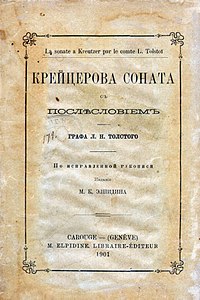
The Kreutzer Sonata Wikipedia, the free encyclopedia The Kreutzer Sonata (Russian: Крейцерова соната, Kreitzerova Sonata) is a novella by Leo Tolstoy, named after Beethoven's Kreutzer Sonata. The novella was published in 1889 and promptly censored by the Russian authorities. The work is an argument for the ideal of sexual abstinence and an in-depth first-person description of jealous rage. The main character, Pozdnyshev, relates the events leading up to his killing his wife; in his analysis, the root cause for the deed were the "animal excesses" and "swinish connection" governing the relation between the sexes.  Summary
Tolstoy's novella inspired the 1901 painting Kreutzer Sonata by René François Xavier Prinet.
During a train ride, Pozdnyshev overhears a conversation concerning marriage, divorce and love. When a woman argues that marriage should not be arranged but based on true love, he asks "what is love?" and points out that, if understood as an exclusive preference for one person, it often passes quickly. Convention dictates that two married people stay together, and initial love can quickly turn into hatred. He then relates how he used to visit prostitutes when he was young, and complains that women's dresses are designed to arouse men's desires. He further states that women will never enjoy equal rights to men as long as men view them as objects of desire, but yet describes their situation as a form of power over men, mentioning how much of society is geared towards their pleasure and well-being and how much sway they have over men's actions.
After meeting and marrying his wife, periods of passionate love and vicious fights alternate. She bears several children, and then receives contraceptives: "The last excuse for our swinish life -- children -- was then taken away, and life became viler than ever." His wife takes a liking to a violinist, and the two perform Beethoven's Kreutzer Sonata (Sonata No. 9 in A Major for piano and violin, Op. 47) together. Pozdnyshev complains that some music is powerful enough to change one's internal state to a foreign one. He hides his raging jealousy and goes on a trip, returns early, finds the two together and kills his wife with a dagger. The violinist escapes: "I wanted to run after him, but remembered that it is ridiculous to run after one's wife's lover in one's socks; and I did not wish to be ridiculous but terrible." Later acquitted of murder in light of his wife's apparent adultery, Pozdnyshev rides the trains seeking forgiveness from fellow passengers.
The Kreutzer Sonata - Wikipedia, the free encyclopedia
Censorship
After the work had been forbidden in Russia by the censors, a mimeographed version was widely circulated. In 1890, the United States Post Office Department prohibited the mailing of newspapers containing serialized installments of The Kreutzer Sonata. This was confirmed by the U.S. Attorney General in the same year. Theodore Roosevelt called Tolstoy a "sexual moral pervert."[1] The ban on its sale was struck down in New York and Pennsylvania courts.[2][3] [edit]Epilogue In the Epilogue To The Kreutzer Sonata, published in 1890, Tolstoy clarifies the intended message of the novella, writing:
“ Let us stop believing that carnal love is high and noble and understand that any end worth our pursuit -- in service of humanity, our homeland, science, art, let alone God -- any end, so long as we may count it worth our pursuit, is not attained by joining ourselves to the objects of our carnal love in marriage or outside it; that, in fact, infatuation and conjunction with the object of our carnal love (whatever the authors of romances and love poems claim to the contrary) will never help our worthwhile pursuits but only hinder them. ”
Countering the argument that widespread abstinence would lead to a cessation of the human race, he describes chastity as an ideal that provides guidance and direction, not as a firm rule. Writing from a position of deep religiosity (that he had explained in his Confession in 1882), he points out that not Christ, but the Church (which he despises) instituted marriage. "The Christian's ideal is love of God and his neighbor, self-renunciation in order to serve God and his neighbour; carnal love, marriage, means serving oneself, and therefore is, in any case, a hindrance in the service of God and men".
During the international celebration of Tolstoy's 80th birthday in 1908, G. K. Chesterton would criticize this aspect of Tolstoy's thought in an article in the September 19th issue of Illustrated London News, writing: "Tolstoy is not content with pitying humanity for its pains: such as poverty and prisons. He also pities humanity for its pleasures, such as music and patriotism. He weeps at the thought of hatred; but in The Kreutzer Sonata he weeps almost as much at the thought of love. He and all the humanitarians pity the joys of men." He went on to address Tolstoy directly: "What you dislike is being a man. You are at least next door to hating humanity, for you pity humanity because it is human."
The Kreutzer Sonata


Το τελος του έργου του Τολστόι
"And all that which a moment before had been so offensive to me now seemed to me so petty,
--all this jealousy,
--and, on the contrary,
what I had done seemed to me so important that I felt like bending over,
approaching my face to her hand,
and saying:
  "'Forgive me!'

"But I did not dare. She was silent, with eyelids lowered, evidently
having no strength to speak further. Then her deformed face began to
tremble and shrivel, and she feebly pushed me back.
  "'Why has all this happened? Why?'
"'Forgive me,' said I.

"'Yes, if you had not killed me,' she cried suddenly, and her eyes shone
feverishly. 'Forgiveness--that is nothing. . . . If I only do not die!
Ah, you have accomplished what you desired! I hate you!'

"Then she grew delirious. She was frightened, and cried:
 "'Fire, I do not fear . . . but strike them all . . . He has gone. . . .
He has gone.' . . .

"The delirium continued. She no longer recognized the children, not even
little Lise, who had approached. Toward noon she died. As for me, I was
arrested before her death, at eight o'clock in the morning. They took
me to the police station, and then to prison, and there, during eleven
months, awaiting the verdict, I reflected upon myself, and upon my past,
and I understood it. Yes, I began to understand from the third day. The
third day they took me to the house." . . .

Posdnicheff seemed to wish to add something, but, no longer having the
strength to repress his sobs, he stopped. After a few minutes, having
recovered his calmness, he resumed:

"I began to understand only when I saw her in the coffin." . . .
 He uttered a sob, and then immediately continued, with haste:

"Then only, when I saw her dead face, did I understand all that I had
done. I understood that it was I, I, who had killed her. I understood
that I was the cause of the fact that she, who had been a moving,
living, palpitating being, had now become motionless and cold, and that
there was no way of repairing this thing. He who has not lived through
that cannot understand it."
*****
We remained silent a long time. Posdnicheff sobbed and trembled before
me. His face had become delicate and long, and his mouth had grown larger.

"Yes," said he suddenly,
"if I had known what I now know, I should never have married her, never, not for anything."
 Again we remained silent for a long time.

"Yes, that is what I have done, that is my experience,
We must
understand the real meaning of the words of the Gospel, --Matthew, V.
28,--'that whosoever looketh on a woman to lust after her hath committed
adultery';
and these words relate to the wife, to the sister, and not
only to the wife of another, but especially to one's own wife."

THE END


*Tanja Pavlovic
Leoš Janáček - String Quartet No. 1, 'Kreutzer Sonata' (1 of 2)
Leoš Janáček - String Quartet No. 2, 'Intimate Letters' (1 of 4)
Leoš Janáček - String Quartet No. 2, 'Intimate Letters' (2 of 4)
Leoš Janáček - String Quartet No. 2, 'Intimate Letters' (3 of 4)
Leoš Janáček - String Quartet No. 2, 'Intimate Letters' (4 of 4)
Il trionfo di Clelia


*Aglaia Raptou
Janáček Kreutzerova sonáta 1/2

*Stratis Vagis
Janacek - In The Mists [1/2]
Janacek - In The Mists [2/2]

*Sergios Malakates
Leos Janacek - Glagolitic Mass (Part 1 of 2)
Leos Janacek - Glagolitic Mass (Part 2 of 2)
Ο Janacek έγραψε πολλά χορωδιακά έργα, αλλά το σημαντικότερο είναι "Γλαγολιτική Λειτουργία", γραμμένη στο παλαιότερο γραπτό σλαβονικό ιδίωμα ! Υποστηρίχθηκε ότι γράφτηκε στο ιδίωμα αυτό για να τονίσει το πανσλαβιστικό ιδεώδες του οποίου ο συνθέτης ήταν θερμός θιασώτης. Ανεξάρτητα από τις πολιτικές σκοπιμότητες το έργο αν και γράφτηκε το 1908 είναι γραμμένο στο μουσικό ιδίωμα του 20ου αιώνα και αποτελείται από οκτώ συνολικά μέρη, εκ των οποίων τα πέντε είναι φωνητικά και αντιστοιχούν στα μέρη της καθολικής λειτουργίας με την παράλειψη του Dona nobis pacem στο Agnus Dei ! Tα μέρη είναι
Úvod – Introduction (orchestra)
Gospodi pomiluj – Kyrie
Slava – Gloria
Vĕruju – Credo
Svet – Sanctus

Agneče Božij – Agnus Dei Varhany sólo (Postludium) – Organ solo
Intrada – Exodus

*Babis Kanas
Leoš Janáček - Sinfonietta
Janacek - In The Mists [1/2]
Janacek - In The Mists [2/2]

*Κλειώ Σεφεριάδου
Jenufa Finale


*Christos Tsiftsis
Janáček: Věc Makropulos - Overture

*Kosmas Pavlopoulos Janacek: A Blown Away Leaf

*Nikolaos Karanidis
L. Janáček - [1/3] Věc Makropulos ("The Makropulos Affair"), Act I
http://www.youtube.com/watch?v=xL7YGsktGCM&feature=youtu.be
L. Janáček - [2/3] Věc Makropulos ("The Makropulos Affair"), Act II
L. Janáček - [3/3] Věc Makropulos ("The Makropulos Affair"), Act III

*Gianni Christopoulos
Leoš Janáček / The Janáček Quartet, 1966: String Quartet No. 1 - "Kreutzer Sonata" - Complete

*Sofia Kouvar
Leoš Janáček - On the Overgrown Path I-IV
Leoš Janáček - On the Overgrown Path IX. In tears V pláci

*Eddy Kouyioumdjian
Talich conducts Janáček Taras Bulba (2/3)